


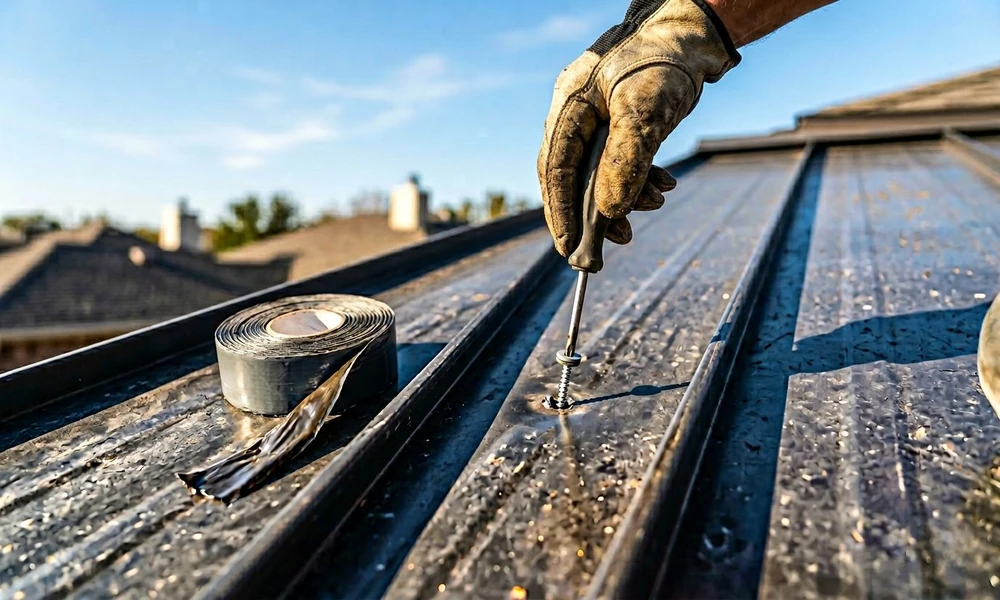
Count the screws on a ribbed metal roof sometime. Installers typically drive one every foot or two along each rib line, and on an ordinary two-story house that adds up to well over a thousand holes punched straight through the weather surface. Every one of them depends on a small rubber washer to keep water out. That one fact tells you more about how metal roofing behaves over the long term than any brochure will.
Homeowners across Northeastern Pennsylvania have good reasons to choose metal. It sheds snow, and it can outlast two or three shingle roofs. Yet the panel style matters as much as the material. That’s why Black Label Builders, a Mountain Top roofing and construction outfit working throughout Wilkes-Barre, Scranton and the wider NEPA region, refuses outright to put an exposed fastener roof on a house. Their crews handle replacements, repairs, metal installs and storm restoration, with free inspections for homeowners who want to know where their current roof stands. The stance is worth unpacking, because the difference between the two systems is easy to miss from the curb.
Simple arithmetic on a ribbed panel
Exposed fastener panels go on fast. They’re often sold as R-panel, ag panel or corrugated. The sheets overlap at the edges, and screws go straight through the flat sections into the deck or into wood strips called purlins. The material is cheaper, the labor is lighter, and the finished roof can look sharp on day one.
The trouble is that a roof gets judged in year fifteen, not on day one. Every hole is a possible leak path, and the seal around it is only as good as the washer, the angle of the screw and how tightly it was driven. An overdriven screw crushes its washer and splits it. An underdriven one never seals fully. A screw set at a slight tilt leaves a gap on one side. Multiply the odds of a small mistake by a thousand-plus holes and the numbers start working against the homeowner.
How a winter on the mountain loosens a screw
Steel grows and shrinks with temperature. A dark panel can top 150 degrees on a still July afternoon and drop below zero on a January night. Across that swing, a thirty-foot run of steel moves roughly a third of an inch. On an exposed fastener roof the screws pin the panel in place, so all that movement goes into the screw holes.
The failure tends to happen in a predictable order.
- Sun and ozone slowly harden the rubber washer until it no longer flexes.
- Daily expansion and contraction work the panel against the screw shank, stretching the round hole into an oval.
- Repeated movement and freeze-thaw cycles in the wood below loosen the screw’s grip, and it starts to back out.
- Melting snow and wind-driven rain find the gap and follow the screw down into the decking.
None of this happens overnight, and that’s what makes it dangerous. A leak from a backed-out screw often starts as a small stain or a soft spot in the sheathing that nobody notices for several seasons. Manufacturers generally expect owners to check fasteners regularly and retighten or replace them. Many roofers suggest budgeting for a full screw replacement somewhere between ten and twenty years in. Few homeowners hear about that maintenance bill before they sign.
Clips that let the metal breathe
Standing seam roofing works with the movement instead of fighting it. Panels run from eave to ridge with raised vertical seams. The fasteners sit beneath those seams on clips screwed to the deck, so nothing pierces the face of the panel where the water actually flows.
Better systems use floating clips that let each panel slide slightly as it heats and cools. A fixed zone near the ridge or the middle of the panel keeps it anchored. The seams either snap together or get crimped with a seaming tool. Snap-lock panels suit most steep residential roofs. Mechanically seamed panels do better on lower slopes and in high-wind spots, because the folded seam resists both water and uplift more firmly.
That engineering costs more. For the same roof, standing seam often runs well above exposed fastener panel, sometimes close to double, depending on gauge, finish and how complicated the roof is. What you get for the money is a roof whose weak points are mostly sealed away from the weather.
Snow, ice and the eave
Metal sheds snow beautifully, sometimes too beautifully. A smooth panel can release its whole load in one slab, and that slab can tear off gutters, flatten shrubs or land on a walkway. Snow guards break the load into smaller, safer releases. They come as individual pads or as rail systems clamped to the standing seams. Clamp-on guards matter, because drilling guards through the panel face brings back the very holes the system was designed to avoid.
Underneath, the eaves still need ice barrier membrane wherever ice dams form. The underlayment across the rest of the roof should be rated for the heat that builds up under metal, since standard felt can break down or stick to the panels over time. Ventilation needs attention too. If the attic stays humid through winter, condensation can form on the underside of the cold metal and drip onto the deck.
The details buyers tend to skip
Gauge. A lower number means thicker steel. Twenty-four gauge stands up to hail and foot traffic better than twenty-six. Twenty-nine gauge, which is common on ag panel, is thin enough to dent under a ladder.
Paint system. PVDF finishes, often sold under the Kynar 500 name, hold their color and resist chalking far longer than silicone-modified polyester coatings. On a roof expected to last decades, the paint warranty often says more about quality than the panel does.
Oil canning. The wide flat pans on standing seam can show visible waviness. Striations pressed into the pan reduce it. A careful installer also keeps the deck flat so unevenness doesn’t show through.
Where ribbed panels still make sense
Exposed fastener panel has a real place. Pole barns, sheds, carports and other outbuildings that aren’t heated or finished inside can live with periodic screw maintenance. On large, simple roofs like those, the savings are hard to argue with. The math changes on a house. There, a leak means wet insulation, stained drywall and a risk of mold, not a damp hay floor.
Reading the quote before signing
When bids come in, compare the panel profile, gauge, finish, clip type, underlayment and snow management, not just the total. A cheaper quote that swaps standing seam for screw-down panel isn’t a fair comparison. Pennsylvania also requires most home improvement contractors to register with the state and to put specific terms in writing. The Office of Attorney General’s home improvement brochure explains what a valid contract should contain and how to check a registration number.
A metal roof is supposed to be the last roof a homeowner buys for a very long time. Whether it lives up to that through decades of mountain winters depends largely on picking a system that keeps its fasteners out of the rain.
